What Is Phin Coffee?
Phin coffee is traditional Vietnamese drip coffee: ground coffee sits in a small metal filter and drips slowly into the cup below, with no machine involved, producing a bold, concentrated cup that's traditionally served over ice with condensed milk.
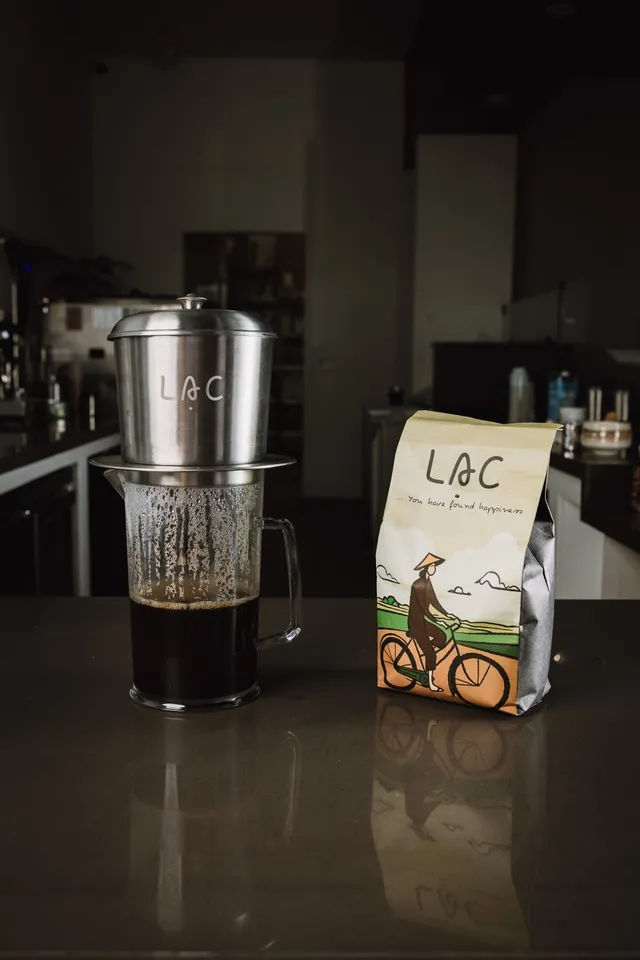
The phin, step by step
- Grounds go in. Coarse-ground coffee — usually a dark-roasted robusta — fills the small metal chamber.
- The press sits on top. A perforated metal disc rests directly on the grounds, holding them flat and even.
- Hot water blooms it. A small amount of hot water saturates the grounds first, then more is added to fill the chamber.
- It drips. Slowly. The lid goes on and the coffee drips through, drop by drop, into the cup or glass underneath — no pressure, no plunging, no rushing it.
- Four to five minutes later, it's done. What's left is a small, dark, syrupy cup of coffee, ready to drink hot or pour over ice.
Phin vs. espresso
Espresso forces hot water through packed grounds under pressure in about thirty seconds. A phin uses no pressure at all — just gravity, patience, and coarser grounds. The result is less crema, more body, and a flavor that reads as darker and a little sweeter even before any milk is added.
Phin vs. pour-over
Pour-over is closer in spirit — no pressure there either — but it's built for lighter, brighter, single-origin beans and a bigger cup. A phin is smaller, stronger, and almost always headed toward condensed milk and ice rather than being drunk black.
Phin vs. a drip machine
A drip machine automates the pour and filters through paper, aiming for a clean, mild cup by the potful. A phin is a single serving, brewed by hand, through a reusable metal filter — closer to a ritual than an appliance.
The everyday tradition
Most phin coffee in Vietnam doesn't end up black. A few spoonfuls of sweetened condensed milk sit in the bottom of the glass, the phin drips directly on top, and once it's done dripping, the whole thing gets stirred and poured over ice. That's cà phê sữa đá — Vietnamese iced coffee with condensed milk, and the drink most people mean when they say "Vietnamese coffee."
It's not a specialty-menu item back home. It's a counter order, a family-gathering staple, the thing that gets made without anyone asking how.
In the shop, and wherever you are
At our shop in Newark, CA, we brew phin coffee the slow way — Vietnamese beans, ground coarse, dripped without hurry, and finished as one of our house drinks like Coco Phê, Pandan Coffee, the House Mocha, or the Viet Old Fashioned. For events, we batch-brew through the phin the same morning and pour it across the Bay Area from our mobile cart’s nitro tap — cascading, velvet-smooth, and still unmistakably phin coffee.
The other half of our counter is Japanese — ceremonial matcha and hojicha powder, packed by hand in Newark, CA. See the powders →
Vietnamese coffee cart catering →See all catering →Matcha cart catering →
Frequently Asked Questions
Is phin coffee stronger than espresso?
It's not stronger in caffeine so much as it's more concentrated in flavor. A phin uses more grounds per ounce of water than a standard drip machine, and the slow drip pulls out more body. Cup for cup it tastes bolder than espresso, even though the brewing method couldn't be more different.
What is cà phê sữa đá?
Cà phê sữa đá is Vietnamese iced coffee with condensed milk — phin coffee dripped directly over a few spoonfuls of sweetened condensed milk, then poured over ice. It's the everyday way phin coffee is served across Vietnam, and it's the drink most people mean when they say "Vietnamese coffee."
What beans are used for phin coffee?
Traditionally a dark-roasted robusta, sometimes blended with arabica. Robusta has more body and caffeine than arabica alone, which is part of why phin coffee holds up so well against ice and condensed milk without tasting watered down.
How long does a phin take to brew?
About four to five minutes from the first bloom to the last drop. It's slower than a pour-over and much slower than espresso — that's the tradeoff for the concentrated, syrupy cup you get at the end.
Do I need a machine to make phin coffee?
No machine at all. A phin is a small metal filter — just a chamber, a press, and a lid — that sits directly on top of a cup or glass. Gravity does the rest.